Intel's AI rally: a CPU shortage, not yet a rotation
Intel rose 33% to Nvidia's 7.5% from late August. Its last quarter grew server volume 9% and price 48%: the market is paying for scarcity, not yet volume.
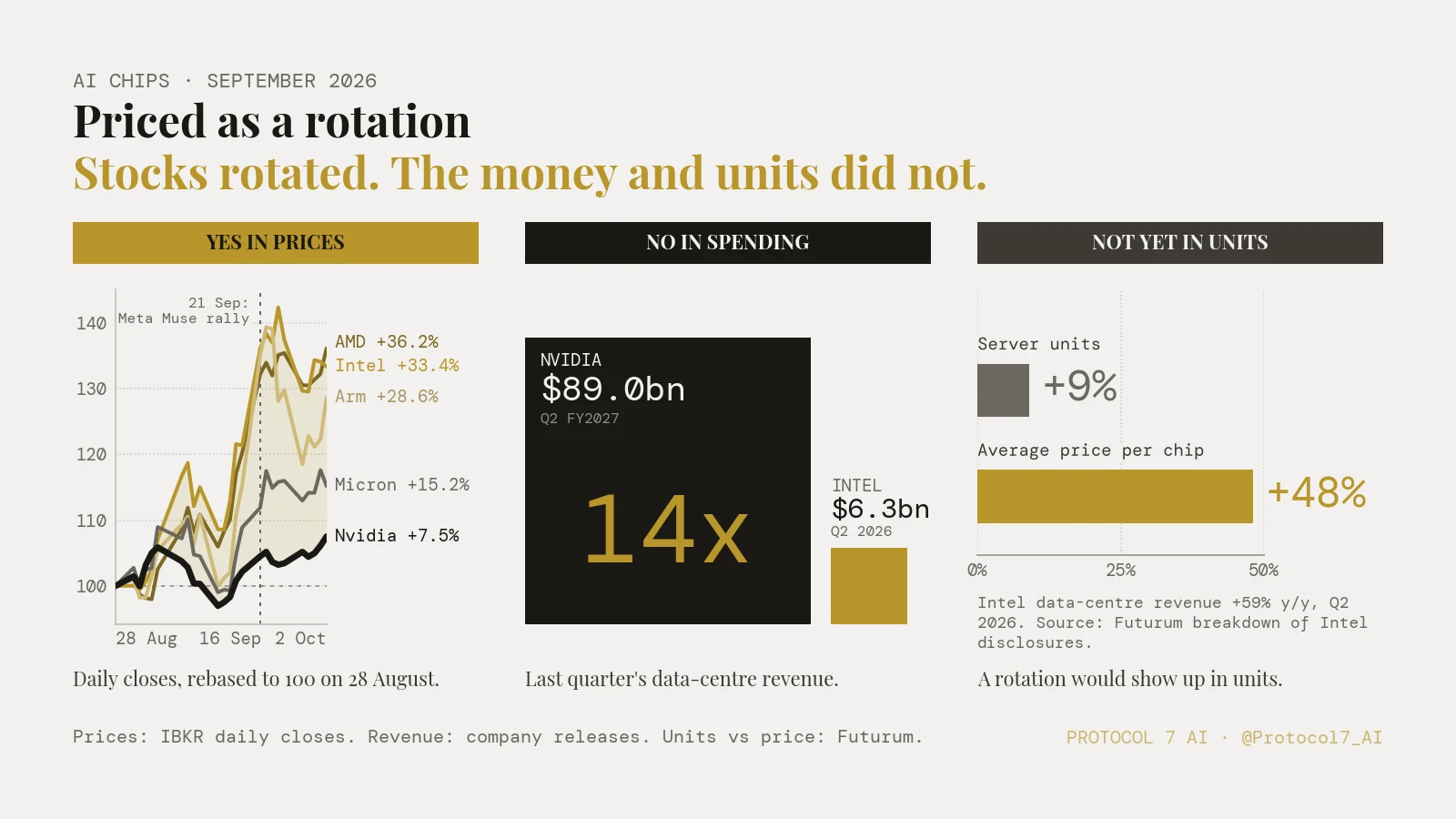
FIG. 1AI chip stocks from Aug 28 to Oct 2, 2026: AMD +36%, Intel +33%, Nvidia +7.5%. Nvidia data-centre revenue is 14x Intel's; Intel server units +9%, price +48%.
Is the AI trade moving from the accelerator to the processor? From August 28 to October 2, Intel rose 33% and Arm 29%, while Nvidia rose 7.5%. Prices say rotation, order books say rationing, and units do not yet say that demand has moved.
Percentages flatter the small. Nvidia is worth about $5.7tn, and AMD, Intel and Arm together roughly $2tn. Over that stretch Nvidia added roughly $400bn of market value, against roughly $500bn for the three together, and AMD's share of that also sells accelerators.
In dollars, September was close to a draw. The year is where the gap lives: by October 2, Intel was up more than 200% since January, Arm about 180% and Nvidia about 26%.
A good part of September came in one session. On September 21 Intel rose 12% and Arm 17%, a day the press credited to early traction for Meta's Muse agent.
That credit rests on timing. Meta itself rose 11% and the Nasdaq-100 almost 3% that day, and no order, guidance or contract was attached to the move. What follows is the case for the agent reading, the case against it, and the question that matters more than the one in the title: how long the shortage lasts.
The memory squeeze ran through the processor socket
An AI server is two machines in one box. A tray of accelerators does the arithmetic. Beside it, an ordinary board of CPUs and memory schedules the work, fetches the data, calls the tools and decides what runs next. Conventional memory only sells into a free processor socket.
Protocol 7's daily brief of September 27 read that board through its memory. Moving DRAM wafers into the stacked memory that feeds accelerators removes more conventional supply than it adds, so conventional contract prices keep rising even on flat device demand.
Three sessions later TrendForce put fourth-quarter conventional DRAM contracts up 10 to 15%. Its release carried the detail that turns a memory story into a processor story: better availability of server CPUs had let cloud buyers take more memory.
The memory could only ship once the CPUs did.
The record also cuts the other way. TrendForce's fourth-quarter range is slower than the 13 to 18% it gave for the third, so the squeeze is still tightening at a falling rate. And the brief named the memory makers as the ones who would collect: Micron rose 15% over the same stretch, under half of what Intel took.
The case for yes is stronger than it sounds
An agent does not spend its time on matrix arithmetic. It waits on tools, databases, other models and its own plan, and that work runs thread by thread on general-purpose CPU cores. The more steps an agent takes per task, the more CPU threads each accelerator needs around it.
The people selling the chips say so, and it is worth separating what they observe from what they project. Observed: in August AMD's chief executive said agentic AI is creating "a new growth vector for server CPUs", and that server CPU supply was tight after demand nobody had planned for. Projected: Nvidia, which now sells Vera, a CPU it built for agentic AI, puts that market at about $200bn. Even Nvidia now sells a CPU pitched at agents.
In April, Commercial Times reported server CPU prices up 10 to 20% since March, with lead times around six months. A market that rations CPUs is a market where CPUs have become the constraint.
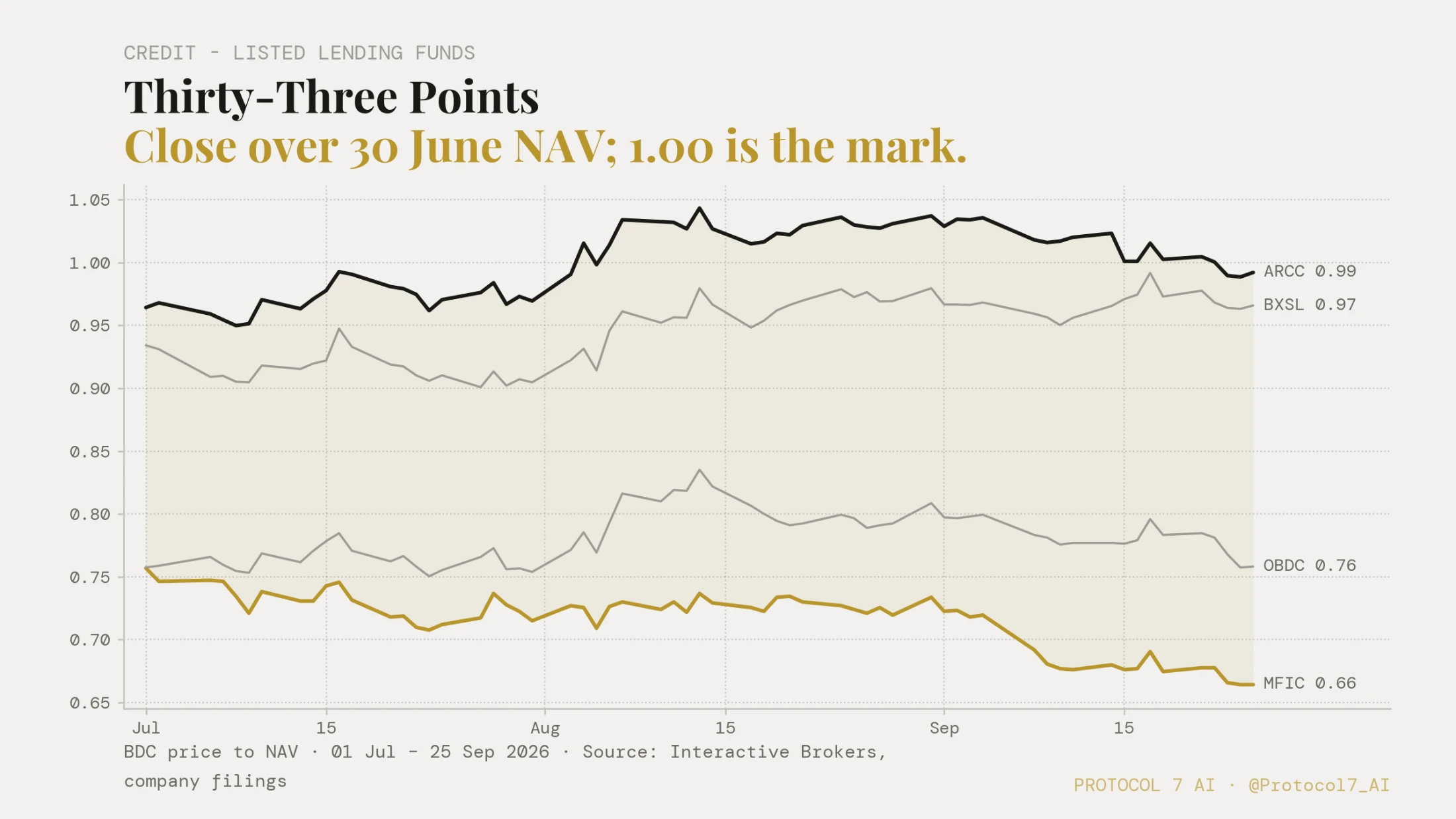
FIG. 2Price-to-NAV of four listed BDCs, July to September 2026: ARCC 0.99, BXSL 0.97, OBDC 0.76, MFIC 0.66, a 33-point gap.
The case for no is in the money and the units
Spending on accelerators has not slowed. Per the companies' own releases, Nvidia's data-centre revenue was $89bn last quarter, up 117% on the year and fourteen times Intel's $6.3bn.
Intel's second quarter is the place to test the rest. Data-centre revenue rose 59%. Per Futurum's breakdown of Intel's disclosures, server volume grew 9% and average selling price 48%, on a mix shift to premium parts. Intel's growth came from what each chip sold for.
That is the signature of a tight market. An agent wave would show up as units.
Intel is an imperfect thermometer, though. It told investors its supply was tight across wafers, substrates and memory, so weak unit growth there could be a ceiling on what it can build rather than on what buyers want. AMD rose 36% but sells accelerators too. Arm, which sells CPU designs and, since March, its own data-centre CPU with Meta as first customer, but no accelerators, is the cleanest read of the three.
The shortage has a longer runway than the rally
If September was a shortage premium, the useful question is how long the shortage lasts. The answer from the supply chain is longer than one quarter, because the queue is not at one door but at three.
A cloud buyer who wants an agent server needs an accelerator fed by stacked memory, a CPU, and conventional memory sticks for that CPU. In the second quarter, TrendForce reported, server CPU shortages slowed server assembly while conventional memory piled up at cloud providers. This year the CPU was the door that would not open.
Next year the queue moves. TrendForce expects conventional server memory supply to grow 15 to 20% in 2027, slower than server CPU shipments. Micron said on its September call that more than 75% of its 2027 output is already committed, that most customer discussions are now about 2028, and that supply will be tighter in 2027 and 2028 than in 2026.
China is adding memory capacity, and TrendForce expects China's own AI build to absorb most of it through 2027. New CPU supply is on a similar clock. Intel raised its 2026 capital spending to more than $20bn and sold $15bn of new shares in August to fund its factories. Its next process, 14A, has one public customer, Tesla, for Musk's Terafab project, with volume production planned for 2028.
The bottleneck moves from the socket to the memory stick, and new factories arrive in 2027 and 2028. A scarcity premium does not need an agent wave to last, only a queue, and the queue is booked.
The expensive money sits at the edges of the build
A price premium has a funding problem the units do not. Amazon, Alphabet, Meta and Oracle issued about $194bn of bonds by early July, Reuters reported, against roughly $108bn in all of 2025.
The hyperscalers themselves still borrow cheaply. With investment-grade spreads near 0.9 percentage points over a ten-year Treasury at 5.28%, an investment-grade issuer pays a little over 6%. The high coupons sit one tier down: SoftBank paid up to 9.75% in September to fund its OpenAI commitment, in the largest high-yield sale on record.
Over September the ICE BofA high-yield spread widened 59 basis points, while investment grade moved 5. Whether this borrowing also lifts Treasury yields is disputed: Capital Economics says AI issuance is not the main driver, and ING puts AI at about a fifth of the rise in long yields, most of it productivity expectations rather than issuance.
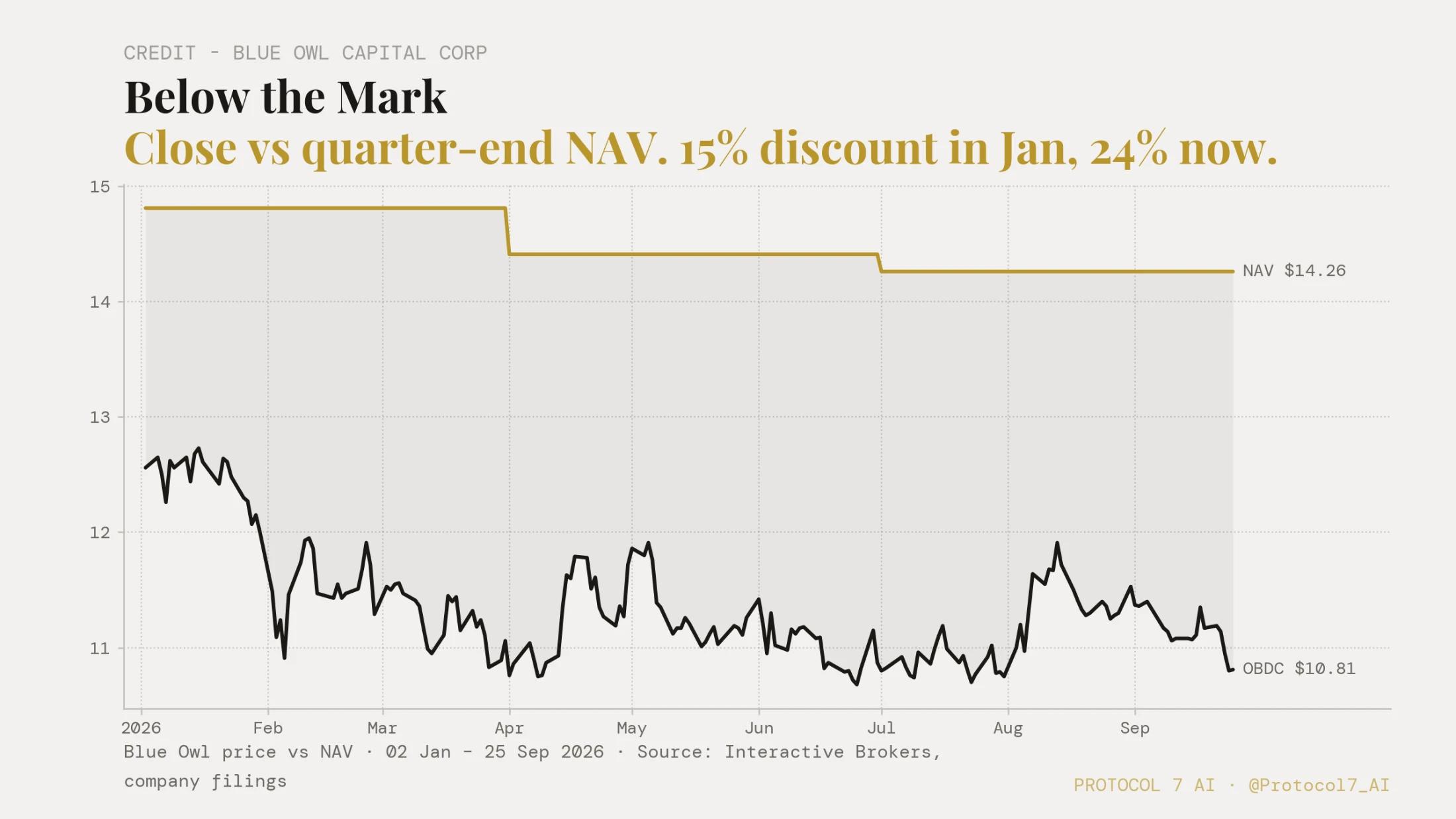
FIG. 3Blue Owl Capital Corp (OBDC) share price vs quarter-end NAV in 2026: the discount widened from 15% in January to 24% in September.
The bill reaches the weakest borrowers first. If credit keeps widening, the first projects to slow are the ones financed at the edge, and a scarcity premium is only as durable as the buyers still able to pay it.
The verdict is maybe, and the next reports decide
Yes in prices. No in spending. Not yet in units.
The processor leg is not new this year. In July, Protocol 7 tracked the AI premium into memory chips, at a point when Intel and Arm were already up more than 200% on the year. Intel's lead over Nvidia peaked in late June, faded through the summer and came back in September. A premium that leaves and returns while supply stays tight is what a shortage looks like.
The same two endings apply as in July: the premium runs while the scarcity holds, and closes when supply catches up or the buyers can no longer pay. The supply chain puts the first ending on a 2027 and 2028 clock. The credit market is where the second would show first.
(1) Intel's third-quarter results, expected October 22. If volume carries a larger share of data-centre growth than price, the agent reading has its first hard evidence. If price still carries most of it, the move is a premium on a tight server market.
(2) AMD's third-quarter report that follows. AMD gives no unit count and does not split CPUs from accelerators in its data-centre line, so its commentary on server CPU growth is the read. Weak units at Intel alongside strong server CPU growth at AMD would mean share moving and Intel's supply capped, not an absent agent wave.
(3) TrendForce's first contract forecast for the first quarter of 2027, expected between mid-December and early January. A flat or negative number would mean the board around the accelerator has stopped tightening.
The read on record: a scarcity premium, not yet a rotation. It becomes a rotation the quarter units, at Intel and beyond, start to carry the growth.
Daily briefs with the decomposed indices, live trigger levels, and full conditional scenarios → Subscribe